



A raft of law changes have been passed to address how Jersey prosecutes violent and sexual offences including intimate image abuse, the creation of AI deepfakes, stalking and strangulation.
Politicians have overwhelmingly approved a series of additions to legislation to introduce better protections for victims of sexual violence, abuse and threats.
The six separate pieces of legislation cover a wide-range of criminal behaviour including tackling the ever-evolving digital world and the risks it holds; making strangulation a standalone crime; and widening the definitions of a series of current offences.
Read: Five new laws proposed to tackle violence against women and girls
Work on the legislation has been ongoing since a taskforce exposed the shocking levels of sexual harassment faced by women and girls in Jersey in November 2023 and made 77 recommendations for change.
Justice and Home Affairs Minister Mary Le Hegarat has called them 'landmark protections',
Chief Minister Lyndon Farnham says that none of the legislation on its own ends violence against women and girl, but each piece makes a clear improvement on how our justice system responds.
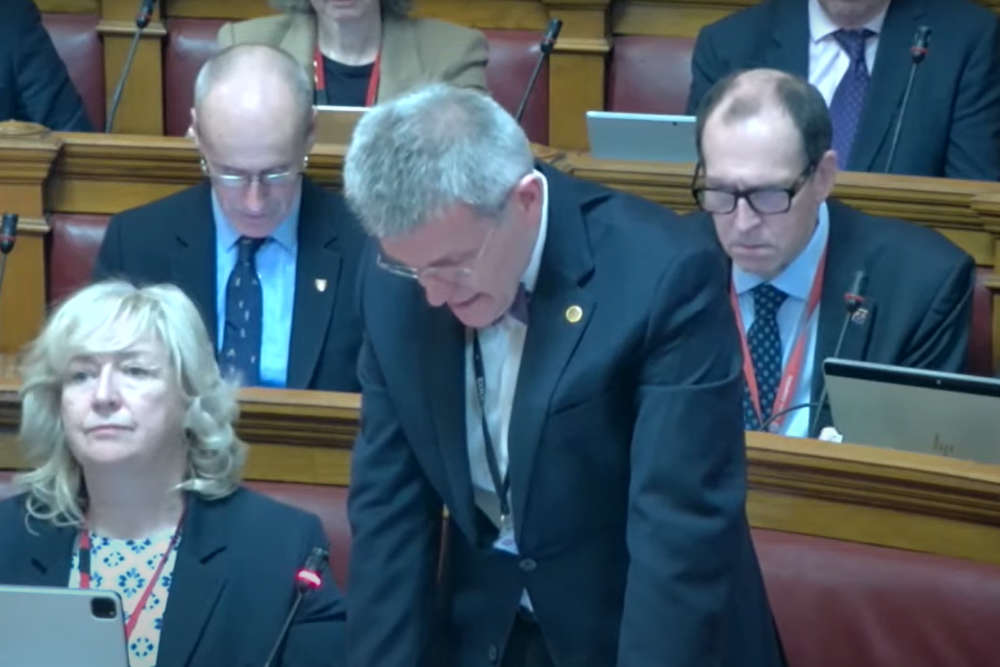
He told the States Assembly
"The Harrassment and Stalking Law recognises behaviour that causes serious fear and harm, the new offences for intimate image abuse respond to forms of abuse that are increasingly carried out online, emergency barring orders will allow the police and the courts to allow space and safety for victims (of domestic abuse) in the immediate aftermath, the offence of strangulation reflects a serious risk that this form of violence poses, and stronger laws around threats and sexual harm send a clear signal that such behaviour is not acceptable and will no longer be tolerated."
Sexual Offences
Changes strengthen the definition of 'sexual grooming of a child' to enable early intervention of criminals attempting to groom a child, preventing further harm.
Improved safeguards will make it an offence to arrange to meet a groomed child or to arrange for a groomed child to travel to a meeting.
Previously, the offence would only stand if a person had already met or communicated with someone aged 15 or younger, was intentionally meeting a child or had travelled with the intention of meeting, to carry out an offence.
This created issues with pursuing a conviction when a meeting had not yet taken place.

Another aspect of the law change has created seven new offences for 'intimate image abuse':
- The possession of an intimate recording without consent;
- The making of an intimate recording without consent;
- The making of a deepfake intimate recording without consent;
- The sharing of an intimate recording or deepfake recording without consent (revenge porn);
- The issuing of threats to share an intimate recording or a deepfake recording (sextortion);
- The sending of unsolicited pornographic images (cyber-flashing);
- Causing a person to create or share an intimate recording.
This means people abusing intimate images will be subject to the same treatment as sexual offenders.
Education Minister Rob Ward says he is pleased to see the clear message of zero tolerance that the laws convey.
"There's responsibility in those who feed division in our society, because it is division that feeds misogyny, and it is that division in our society that we must address whenever we see it."
Definitions of indecent images of children will also be strengthened to align Jersey with other jurisdictions.
Indecent images of children will be of a person who is younger than 18, which will allow the Digital Forensics Unit to use age recognition software that is used in the UK.

There will also be no need to prove a motivation when it comes to prosecuting someone for voyeurism.
It will be an offence for anyone to intentionally or 'recklessly' watch another person performing a private act, without their consent.
Harassment and Stalking
Four new offences have been introduced to tackle harassment and stalking in Jersey:
- Harassment - when a person causes another to feel anxiety, alarm, or distress, on more than one occasion;
- Aggravated harassment - when a victim of harassment fears violence will be used, on more than one occasion;
- Stalking - when a person's behaviour involves harassment and involves stalking behaviour such as surveillance, intrusion and interference;
- And, aggravated stalking - when a victim of stalking fears violence will be used, on more than one occasion.
New measures will strengthen protections for victims, regardless of whether their harasser has been convicted.
Research by a Violence Against Women and Girls (VAWG)Taskforce found 28% of the victim-survivors surveyed reported experiencing stalking.
Many described being stalked or harassed by an ex-partner.
Behaviours include frequent calls and messages, showing up at their home or place of work and going as far as breaking into their homes to damage their property.
Former legislation lacked a specific offence of stalking, which created 'a number of issues' for the criminal justice system.
Between 2016 and 2021, 192 reports of stalking were made to the Jersey Police.
Only two resulted in convictions.

The new offences will allow the courts to issue a 'Stalking Protection Order' against someone, which involves a variety of restrictions and requirements to prevent them from carrying out further stalking behaviours or harming their victims.
This includes:
- Prohibiting them from contacting or coming within a specified distance of the person they are believed to have engaged in stalking behaviour towards;
- Prohibiting them from coming within a specified distance of certain premises;
- Prohibiting them from engaging in any type of surveillance of a certain person;
- Prohibiting them from taking videos or photographs of a certain person;
- Prohibiting them from referring to a certain person on social media (both directly and indirectly);
- Requiring them to report to the police station at specified intervals;
- Requiring them to attend specified counselling or education;
- Requiring them to surrender certain devices to the police or provide the police with access to those devices;
- And any other restriction or requirement that the Court considers necessary.
Domestic Abuse
Victims of domestic abuse will also see more safeguards, improving protections even if the perpetrator has not been convicted.
The Home Affairs and Justice Minister reports that the UK Femicide Census revealed that, in 2018, 37 of 91 women killed by a male partner were either separated or were taking the steps to separate from their partner. 11 of those 37 were killed in the first month of separation.
Emergency Barring Orders will be used as a tool for creating space between a victim and their attacker to remove immediate danger.
This involves giving authorities the power to order the abuser to leave the home of a victim and prevent them from returning or contacting them.
Without this, the police do not have the ability to do this whilst the investigation is ongoing.
Pre-conviction Emergency Barring Notices will be issued by the police, and post-conviction Orders will be issued by the courts.

Strangulation
Strangulation becomes a standalone offence.
It follows recommendations from the VAWG Taskforce review, which revealed that even small amounts of pressure can cause 'very serious harms'.
"Strangulation may be the second most common cause of stroke in women under 40."
- Bangor University
Data from the Institute for Addressing Strangulation states that to cause serious harm to areas of the neck takes less than a third of the force in the average handshake between two men.
It also says that half of strangulation victims show no visible external injuries to their head or neck.
Presenting the Strangulation Law to Jersey's parliament, the Home Affairs and Justice Department revealed that an independent review of pornography, published in 2025, emphasised the prevalence of 'choking' on 'mainstream pornography sites', with concerns about the normalisation of strangulation in younger generations.
Minister Mary Le Hegarat made a revelation about the subject being raised in Jersey's schools:
"Teachers are reporting repeated cases of teenage boys asking how they can safely strangle their partners.
"This is what we're up against.
"Strangulation can never be safe."
The standalone offence distinguishes strangulation from the existing offences of Common assault and Grave and Criminal assault.
It is defined as suffocating, choking and restricting a person's breathing and blood flow to the brain by any means.
In Jersey, a total of 116 crimes relating to strangulation were recorded by the police between 2019 and November 2025; 76 were categorised as Grave and Criminal assault, with the remaining as Common assault.
Almost half of the crimes were committed by a partner.
Data from the Jersey Domestic Abuse Service shows that in 2025 alone, there were 70 strangulations.
Threats of Violence
Politicians also voted to pass an amendment to the Crime (Public Order) Law to include threats of violence.
It has been described as 'closing a gap' in Jersey's legislation that was highlighted by the VAWG Taskforce.
Threats to 'kill, rape or cause serious physical injury to any person' are currently covered by the law
However, the amendment would see threats relating to 'non-consensual penetration, causing sexual acts, all sexual offences against children and threats to carry out female genital mutilation'.
The law changes will take effect at a later date, to be announced.
 26-year-old Pier Road mural to be replaced
 Family of Guinea pigs with JSPCA after Devil's Hole rescue
 CI trade body warns of building delays after SGB shuts
 Food venues required to comply with new food safety standards
 Oh yes it is, Jersey's first professional pantomime!
 Jersey's hospitality sector faces changes with new Alcohol Licensing Law
 Bye-bye Bath Street Blockbuster: £500K to update street mapping
 Deputy Philip Ozouf suspended





Comments
Add a comment