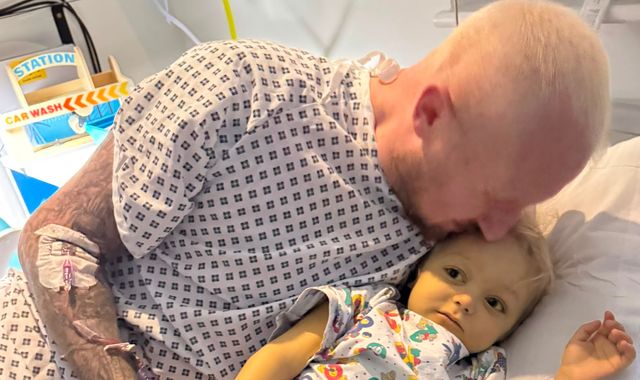
A man who donated part of his liver and bowel to his son in an "extremely rare" transplant has described it as the "greatest privilege" of his life.
Six-year-old Harry Jackson received the transplant at King's College Hospital in London and is believed to be one of only around 10 children worldwide to undergo the procedure.
Harry was born with malrotation, an abnormality of the bowel that occurs when the baby is developing in the womb.
He was at risk of volvulus, a potentially life-threatening complication of malrotation that occurs when the bowel twists, cutting off the blood supply to that part of the bowel.
Harry also developed intestinal failure-associated liver disease (IFALD), a progressive liver condition caused by years of receiving an intravenous form of feeding to manage his condition.
His parents, Annie Cerveno and Gary Jackson, met with the transplant team to discuss the possibility of a liver and bowel transplant and if they were a match.
The couple from Cambridge subsequently had tests, and, following weeks of assessments, Mr Jackson was confirmed to be a 98% human leukocyte antigen (HLA) match with Harry, meaning their immune systems were incredibly similar.
In January last year, Mr Jackson underwent the 17-hour operation at King's College Hospital to donate about 20% of his liver and 1.5m (4-5ft) of his small bowel to his son.
He said: "When you're a parent, you'd give your child anything in a heartbeat.
"So when I was told I could donate part of my liver and bowel to Harry, there was never a decision to make.
"I was just incredibly grateful that I had the opportunity to do something that could help save his life and give our little boy a second chance."
'The greatest privilege'
Mr Jackson, who had to lose six stone and give up alcohol prior to the operation, said the process had been "mentally and physically demanding" but insisted he would "do it all again without a second thought".
"Watching him recover and knowing that I had been able to play such a significant part in giving him that chance is something I'll never be able to put fully into words," Mr Jackson added.
"It remains the greatest privilege of my life."
Ms Cerveno admitted that they knew Harry would one day have to undergo a bowel transplant but hoped it would be "many years away".
However, she said that "everything changed" when his liver began to fail.
"As parents, you feel completely helpless watching your child wait for something so uncertain," Ms Cerveno said.
"The thought that one of us might be able to donate and give Harry that chance was something we wanted to explore immediately. If there was any possibility we could help him ourselves, we had to try."
Read more from Sky News:
Mother who killed baby with heat from hairdryer to appeal
Body of woman found in park was inside bin bag
'Extremely rare' transplant
Currently, around three in 100 liver transplants performed in the UK are from living donors, with the majority of these for children.
Explaining the benefits of living organ donation, Ms Miriam Cortes-Cerisuelo, liver transplant consultant surgeon and clinical lead for transplant surgery at King's, said: "The donated organ is in excellent quality from a healthy donor, and the process allows better preparation and planning for the surgery.
"As a result, there are much better chances of success for the transplant.
"However, living donor transplants involving the small bowel and liver, such as the one that saved Harry's life, are extremely rare.
"There are around just 10 cases worldwide that we know of, all involving children."

(c) Sky News 2026: Man donates part of liver and bowel to save son in 'extremely rare' transplant
 Man charged with murder over deadly house fire
 Hundreds arrested and weapons seized at Notting Hill Carnival
 US army secretary Dan Driscoll to leave role
 Joshua Kushner, would-be FIFA investor linked to Trump, breaks silence on World Cup sell-off plans