


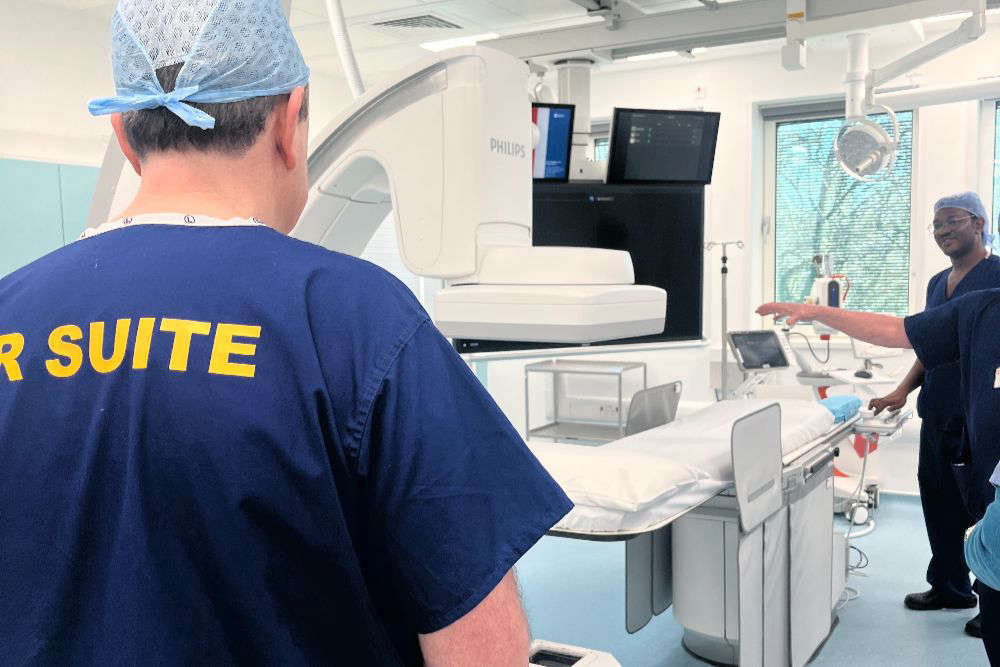
A £3 million radiology suite at Jersey's General Hospital is improving how doctors deliver keyhole treatments for conditions including blood clots and cancers.
The Interventional Radiology (IR) suite has opened following a 16-month refurbishment and installation of 'state-of-the-art' equipment.
It uses imaging technology, including X-rays, CT, MRI and ultrasound, to allow clinicians to treat certain conditions by using catheters and wires.
The keyhole procedures are 'minimally invasive', which helps to reduce pain and recovery time for patients.
Consultant Radiologist, Dr Nolan Walker, says they can now do all of the most modern and up-to-date procedures with minimal radiation.
"What it means for patients is that the need to go off-island for many procedures is much less, and we can provide the services on-island, which means no need for visits to the UK, Southampton etc.
"Interventional Radiology uses an X-Ray machine to X-Ray the patient live, and then you put a tiny needle into one of the arteries or veins of the patient and navigate your way using the X-Ray to the part of the body where you're either trying to block a vessel that's bleeding or unblock a vessel that should be open.
"It all uses X-Rays and a tiny pinhole insertion point.
"We can do all of this on-island and often as a day case, which means you can go home a few hours after the procedure, so it's a lot more convenient and cheaper."
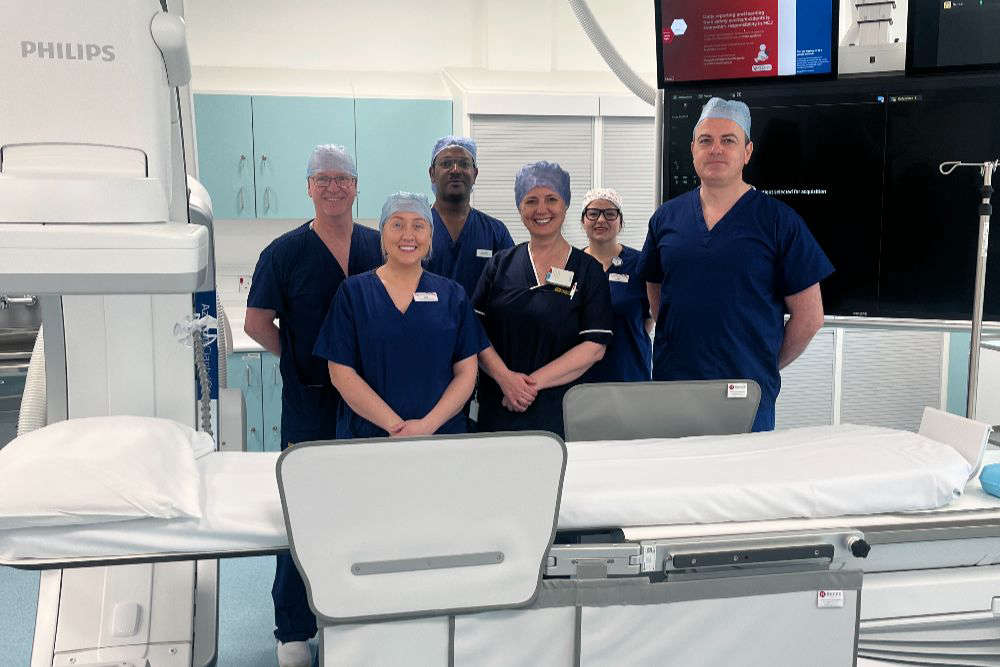
There have also been some improvements to the radiology room, which will help to reduce waiting times.
More procedures will also be able to be carried out on-island as a result, including:
- Treatment of vascular conditions, such as blood clots and bleeding vessels,
- Keyhole treatment for fibroids,
- Treatment for enlarged prostates,
- Drainage of infections and abscesses,
- Insertion of long‑term intravenous lines for patients requiring ongoing treatments such as chemotherapy.
the £3 million cost has come from charitable donations to Health and Care Jersey from the John Clive Le Seelleur Trust and the E J Bailhache Fund.
Dr Nolan Walker explains how the funding has had a positive knock-on effect:
"Keeping everything up to date and state-of-the-art and having all the equipment as good as it can be means that we can maximise the treatments for the patients here on-island and enable them to stay having the best care.
"There is no real need to go to the UK; there is no benefit of going to the UK because we have the best stuff here."
 More than 25 puffins a week wash up on Channel Island beaches
 DFDS introduces 'Islander's Rate' discount
 First Point signs Lido contract
 Two cars taken for joyrides in 48 hours
 Weekender to return in September
 Ambulance responder running London Marathon to fund defibrillators
 JSPCA to close vet clinic for non-shelter animals
 Applications open for postal voting in June election





Comments
Add a comment