

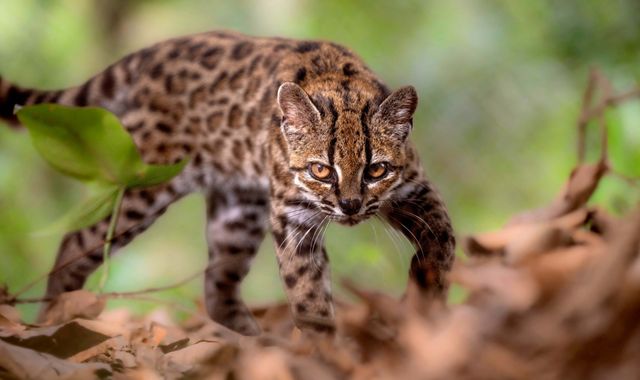
A previously unknown species of wild cat has been identified in South America.
Smaller than the average domestic cat at around 46cm long, it was found in Bolivia's Yungas region - a misty cloud forest between the Andes and the Amazon.
It is the first time in over a century that a new living cat species has been formally identified.
Called Tilcayo by local communities, it has been given the scientific name Leopardus tilcayo and is part of the tiger cat family found across much of the continent.
However, genetic tests confirmed it is a new species.
"Its fur is light brown... with irregularly shaped rosettes across its body," said Paola Nogales-Ascarrunz, one of the study's authors, and a biologist and National Geographic explorer.
Not much is known so far about its lifestyle, but researchers believe it's more active at night and probably eats small rodents.
Fellow lead author Jonas Lescroart, from the University of Antwerp in Belgium, said their work is based on two live examples of the cat - one of which is now in a Bolivian wildlife sanctuary after previously living in a family home.
They also analysed photos from camera traps.
The team looked at DNA data from 38 examples from several countries and found tiger cats are in fact five genetically distinct species.
They believe Tilcayo separated from others in the group about 1.4 million years ago.
"We never expected this Bolivian tiger cat to be a separate species, and no one had ever proposed it as a different animal, subspecies or otherwise," Mr Lescroart said.
Tiger cats are considered as two "vulnerable" species and an upcoming review by the International Union for Conservation of Nature will now assess the five lineages separately.
This could lead to Tilcayo being declared endangered in its own right.
Read more from Sky News:
Ebola red zone hit with another crisis
FA chair calls for release of files on Infantino's World Cup plan
The cat's home in the Yungas is one of the region's most at-risk ecosystems due to threats such as deforestation, agriculture, human-caused fires and mining.
"Showing the general public that even in a flagship group such as cats... there are still new species to be discovered may transmit an important message," said Eduardo Eizirik, an evolutionary biologist and a senior author of the study.
"There are many undiscovered species out there in the world, and they are at risk of disappearing before we even discover them."

(c) Sky News 2026: New species of wild cat identified in Bolivia - first for more than 100 years
 British woman rescued after shoot-out between Malawi police and kidnappers
 Man dies in fifth fatal shark attack this year in Australia
 British man granted bail after being detained in India for nearly nine years
 Canadian PM Mark Carney aims dig at Donald Trump as he addresses EU