
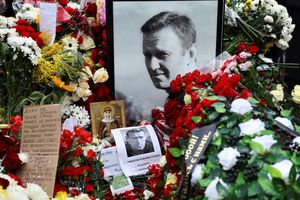
It is no coincidence that the UK and its allies chose a security conference in Munich to accuse the Kremlin of killing Russian opposition leader Alexei Navalny with dart frog poison.
The extraordinary announcement on Saturday seemed deliberately timed to grab global headlines in much the same way as the dissident's actual death did.
The news that Mr Navalny, 47, had died in prison in Russia broke on the opening day of the same Munich Security Conference of global leaders almost exactly two years ago.
Naming the person or government allegedly responsible for such a political assassination - if the claim of poisoning is substantiated - is a form of information attack.
The intent is to make sure perpetrators cannot hide in the shadows and could face serious consequences such as sanctions or even criminal convictions.
The thinking - which might well be wildly optimistic - is that greater scrutiny could make a hostile state think twice before sanctioning plots to kill political opponents or other enemies.
It is doubtful that the efforts by Yvette Cooper, the British foreign secretary, and her German, Swedish and Danish counterparts, who made the poisoning announcement, along with Mr Navalny's widow, will deter the Kremlin from such allegedly ruthless action in the future.
However, their words are at the very least evidence of a growing resolve amongst NATO allies to stand up to what they regard as attempts by President Vladimir Putin to attack their countries and societies in the grey zone - under the threshold of conventional war. This also includes acts of sabotage, cyber hacks and disinformation spread online.
Speaking to a group of journalists about the case, Ms Cooper spelt out clearly the charges she was levying against Moscow.
"We have confirmed that a deadly toxin was found in Alexei Navalny's body and that toxin has been identified as a toxin that is found in Ecuadorian dart frogs," she said.
"Only the Russian government had the means, the motive and the opportunity to use that toxin against Alexei Navalny in prison and that is why we are here today to shine a spotlight on the Kremlin's barbaric attempt to silence Alexi Navalny's voice. To show that the Russian government has contempt for its citizens and the willingness to use this deadly toxin."
Yulia Navalnaya, Mr Navalny's widow, also spoke. She learnt about her husband's death while at the Munich conference on 16 February, 2024.
"It was the most horrible day in my life," she recalled, visibly upset.
"I came to the stage and I said my husband Alexei Navalny was poisoned. What could else happen with Putin's number one enemy in Russian prison?
"But - sorry, it is very difficult for me to say this - what could else happen with my husband in Russian prison? But now I understand and I know it is not just words. It is scientific proof."
British scientists played a key role in identifying the deadly neurotoxin - called epibatidine - that was allegedly administered to Mr Navalny.
The poison is found in the skin of the South American dart frogs, although Sky News understands it is likely the version used in the alleged murder was manufactured in a laboratory.
The effects of the poison are devastating, causing paralysis, respiratory arrest and an agonising death.
If - as claimed by Britain - the Kremlin did choose to use such an exotic substance to silence a critic, it demonstrates an unusual level of ruthlessness.
The Kremlin is already accused of trying to kill Mr Navalny in 2020 with a Novichok nerve agent - the same chemical weapon deployed against a former Russian spy on the streets of Salisbury two years earlier.
Fighting back, Moscow is well-practised and highly adept in the information space.
Its embassy in London was quick to respond to the allegations about dart frog poisonings.
"The goal of this ridiculous circus performance is transparent: to stoke waning anti-Russian sentiment in Western society. If there's no pretext, they laboriously invent one," it said.
"The method chosen by Western politicians - necropropaganda - is truly shocking. This isn't a quest for justice, but a mockery of the dead. Even after the death of a Russian citizen, London and European capitals cannot give him peace, which speaks volumes about the instigators of this campaign."

(c) Sky News 2026: Why Navalny dart frog poison announcement was deliberately timed
 Russia killed Alexei Navalny with dart frog poison, UK and allies say
 Demi Edmunds: 'Funny, kind and caring' teenager killed in three-car collision in Cwmbran, South Wales
 Abdul Halim Khan: Former east London imam guilty of child sexual abuse after claiming he had 'supernatural powers'
 Britain will deploy warships to the Arctic, Starmer tells Munich Security Conference